

Hash and weed are two different products that are made from the plant Cannabis sativa. “Hash” is short for “hashish,” which means grass in Arabic. The term “weed” refers to the way cannabis plants grow quickly and is generally used to refer to the dried buds.
The main difference between hash and weed is that hash is a more concentrated form of cannabis. Weed consists of the dried whole cannabis flower whereas hash is made from the resinous trichomes that are separated and compressed into a ball or block.
What Is Weed?
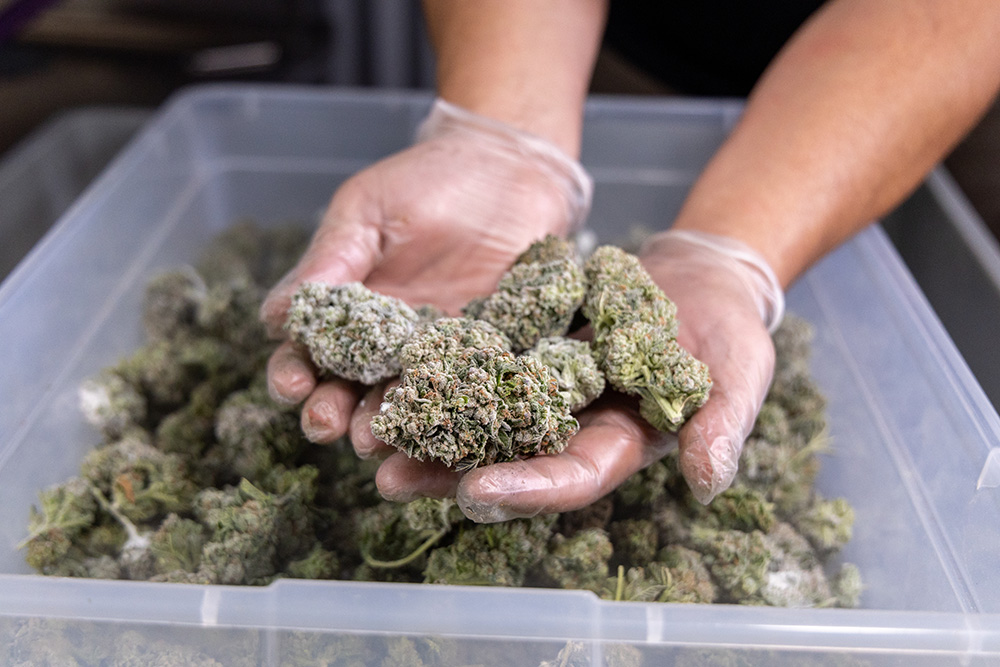
“Weed” or “smoking weed” refers to the dried and cured buds of mature female cannabis plants. These buds consist of the stems, flowers, and hair-like resin glands (trichomes) that grow on the buds. The small leaves on the buds—known as sugar leaves—are generally trimmed off either before or after the buds are dried.
 How Weed Is Made
The traditional process for making weed (AKA flower) is as follows:
- The buds are harvested and the fan leaves are trimmed off.
- The buds are hung upside down in a drying room for a few days to a few weeks.
- After drying (or before drying), the sugar leaves are trimmed using scissors.
- The dried and trimmed buds are jarred for curing.
- After curing, the buds are ready for consumption.
More recently, various machines have been introduced to make this process more efficient:
- Air conditioners, fans, humidity controls, and even fully automated drying rooms can be used to ensure an optimal drying environment.
- Bladed and bladeless trimming machines can be used to reduce the amount of hand-trimming required. The Original Resinator, for example, completes around 85% of the trimming process using liquid CO2 and gentle rotation for a result that’s almost indistinguishable from a hand-trimmed finish (contact us to learn how our revolutionary bladeless trimmer can save you time).
- Freeze dryers can be used to dry fresh cannabis buds in as little as 24 hours with increased cannabinoid, terpene, and color preservation. Our award-winning Crop-to-Cure® process combines CO2 trimming (Cryo-Trim®) and freeze drying for an unmatched result.
What Is Hash?
Hashish, or hash, is a traditional cannabis product made from the resinous trichomes of the female cannabis plant, rather than the whole bud. This product is especially popular in the Middle East, Africa, Asia, and Europe. Hash is generally a dark yellow, reddish brown, or dark brown color, depending on how it is made and stored.
How Hash Is Made
There are two traditional hash-making methods:
- Dry sieving
- Hand rubbing
Dry Sieving
Dry sieving is the most common method used to make hash in Morocco and Lebanon. Dry sieving is also used in Afghanistan alongside hand rubbing.
- Dried cannabis buds are rubbed or shaken over a screen or sieve.
- The mixture of trichomes and plant matter (kief) that falls onto the screen is refined through a graduated series of screens or sieves to filter out the plant matter.
- The refined dry sift is heated and pressed to rupture the trichome heads, release the sticky resin inside, and shape the sticky paste into a brick or ball.
- The hash is cured or aged.
- The hash is ready for consumption.
Hand Rubbing
Hand rubbing is used in Afghanistan alongside dry sieving and is the most common hash-making method in India, Pakistan, and parts of South Asia. Traditional hand-rubbed hash from live cannabis was originally referred to as charas in the Indian subcontinent.
- The buds are rubbed between a person’s bare hands so that the resin sticks to their skin.
- The resin is scraped off and molded into the desired shape (usually a stick).
- The stick is aged or cured.
- The hash is ready for consumption.*
*Please note that this is not common in North America as the process is not considered sanitary.
Modern Concentrates
Making hash in the ways that we’ve described so far has been typical up until the modern era. However, with the growth of the legal cannabis industry in the United States, several new methods for making concentrated cannabis products have been developed and refined. From a commercial perspective, these modern concentrates have far greater consumer appeal than hash. Traditional hash bricks and charas are very niche and (unless you’re a very old hash consumer) are nowhere near as good as even low-quality modern products.
Dry Sift
Modern dry sift is much more refined than traditional hash and is typically sold loose rather than pressed into bricks, sticks, or balls.
- The trichomes are mechanically separated from the cannabis buds using liquid CO2 or dry ice. The resulting kief is refined using a series of micron-rated mesh screens. Sift made with dry ice tends to be contaminated with huge amounts of plant matter, which is why we recommend our Cryo-Sieve® process using liquid CO2. Our Resinator OG and XL models excel at separating top-quality dry sift. You can also use our dry sift screens to sift kief by hand for home use.
- All of the remaining plant matter can be removed using static electricity (“Static Tech”). This process can be used to achieve full-melt dry sift in certain cases, but is difficult to pull off unless your processes and input material are nearly perfect.
Ice Water Hash
Ice water hash refers to a concentrate that’s achieved using cold water, ice, and agitation. This concentrate is also referred to as “bubble hash” because it bubbles when dabbed. This is the process for making ice water hash:
- Cannabis plant material is submerged in an ice water bath, causing the trichomes to freeze and become brittle.
- Manual or mechanical agitation causes the trichome heads to fall off and sink to the bottom of the vessel where they are collected in a series of micron-rated “bubble bags” according to aperture or pore size.
- The resulting slurry is dried in a cool room or freeze dryer.
Solvent Extraction
Solvent-based extracts started with alcohol extractions in the 1970s. Hydrocarbon extraction began in 1999 when Indra Gurung posted the process on the Erowid website. Butane, propane, hexane, ethanol, and supercritical CO2 are the most common solvents used.
- Cannabis plant material is placed into a chamber through which the solvent is passed.
- The active compounds are dissolved by the solvent.
- The solvent is purged from the extract.
- The extract is dewaxed, winterized, or processed further to create a range of products.
Rosin
Rosin is the solventless counterpart of solvent-based extracts. This extract was developed by Phil Salazar (aka Soilgrown) in 2015 and has grown to become the most popular solventless dabbable product on the market.
- Ice water hash, dry sift, kief, or dried cannabis flower is placed inside a rosin bag, which is placed inside a folded piece of food-grade parchment paper.
- This packet is pressed between the heated plates of a rosin press.
- The heat combined with pressure causes the cuticles of the trichomes to rupture and the resin to flow out onto the parchment paper for collection.
- Various post-processing techniques involving cold and warm storage can be used to create a wide variety of products. These techniques are popularly employed by modern hash makers.
- The rosin (or its derivative product) is ready to consume.
How Weed and Hash Are Consumed
Both hash and weed—as well as the concentrates we’ve described above—can be combusted and inhaled, or eaten if properly decarboxylated and infused into food.
- Hash is traditionally smoked or decarbed into an oil and eaten.
- Weed or flower is traditionally smoked in pipes, wraps, and bongs. More recently, it has become possible to vaporize cannabis buds using a dry herb vaporizer. The buds can also be used to make tinctures, edibles, and topicals.
- Modern concentrates are typically dabbed or vaporized. Solventless concentrates can also be used to make edibles and topicals.
The Potency of Hash vs Weed
The potency of both weed and hash depends on the starting strain. Hash generally has a higher concentration of cannabinoids than flower.
- THC levels in cannabis flower are around 15%, on average, according to research published in April 2023.
- THC levels in hash are—on average—between 5 and 40% for the years 1995 to 2014. These days, it’s not uncommon to have it test at 50-60%. Hash is generally thought to be around three times stronger than the starting strain.
- THC levels in modern concentrates range up into the 90s.
It’s important to note that traditional hash isn’t always more potent than flower because it could have been made from a strain with very little THC or may contain fillers that reduce the THC percentage by volume. Hash should always be tested in a lab to confirm the cannabinoid levels and identify any potential contaminants.
Taste and Aroma of Hash vs Weed
Hash is said to taste more earthy and less floral than flower. Hand rubbed hash is said to taste more floral and spicy than dry sieved hash. Ultimately, the taste and aroma probably come down to the strain more than the method of separation. Hash that tastes acrid or like chemicals, plastic, mold, or dung(!) is probably unsafe and should not be sold, purchased, or consumed.
Effects of Hash vs Weed
Cannabis consumers report a range of effects for both hash and weed, with some products said to have more cerebral effects and others said to be more physically relaxing. One would expect hash to have stronger effects because it’s a more concentrated product. But again, this depends on the starting strain and product purity.
Legality of Hash vs Weed
In the United States, both weed and hash are illegal under federal law if they come from the marijuana plant. Marijuana is defined as having more than 0.3% THC on a dry weight basis.
At the state level, marijuana products have been legalized for medicinal and/or recreational use in a majority of states and the list of legal states continues to grow. Please note that products in states that have legalized cannabis use must be grown and processed within that state and can’t be transported across state lines.
Hash vs Weed: Which Is Better?
Hashish and marijuana flowers can both have wonderful aromas and effects if prepared properly from high-quality starting material. However, in the modern market, buds and modern concentrates provide far more versatility in terms of processing and appeal to modern customers.
If you plan to produce and sell dried buds and/or cannabis concentrates in dispensaries, it’s essential to use high-quality starting material and equipment that preserves that quality from harvest to shelf. Whether you focus primarily on buds or concentrates, it’s the purity, cleanliness, aromas, and effects of your products that will keep your customers coming back.